
TL;DR: Canonical pretrains visual representations by modeling camera viewpoint change as an SO(3) rotation in latent space, allowing visuomotor policies to generalize to unseen camera angles without calibration.
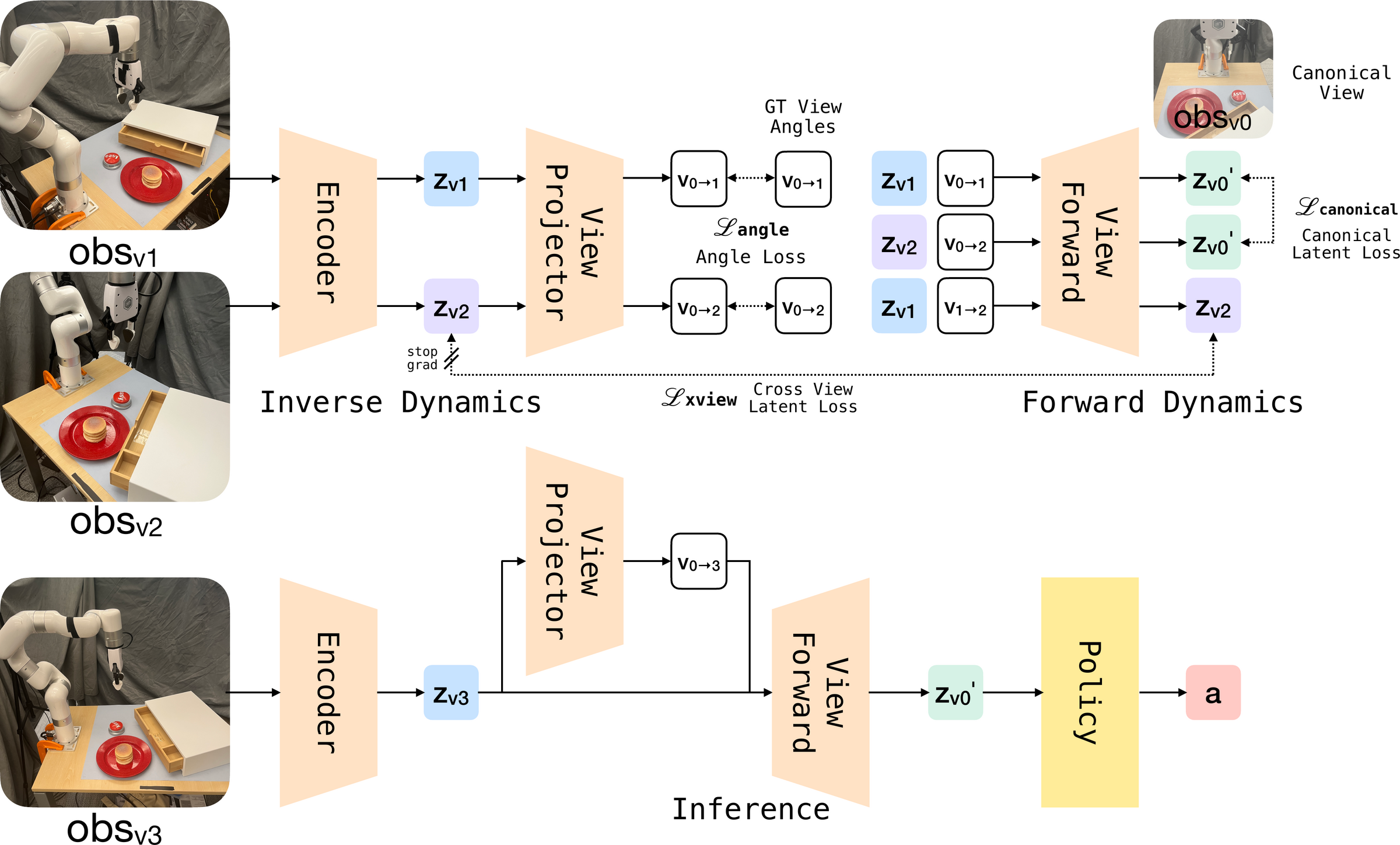
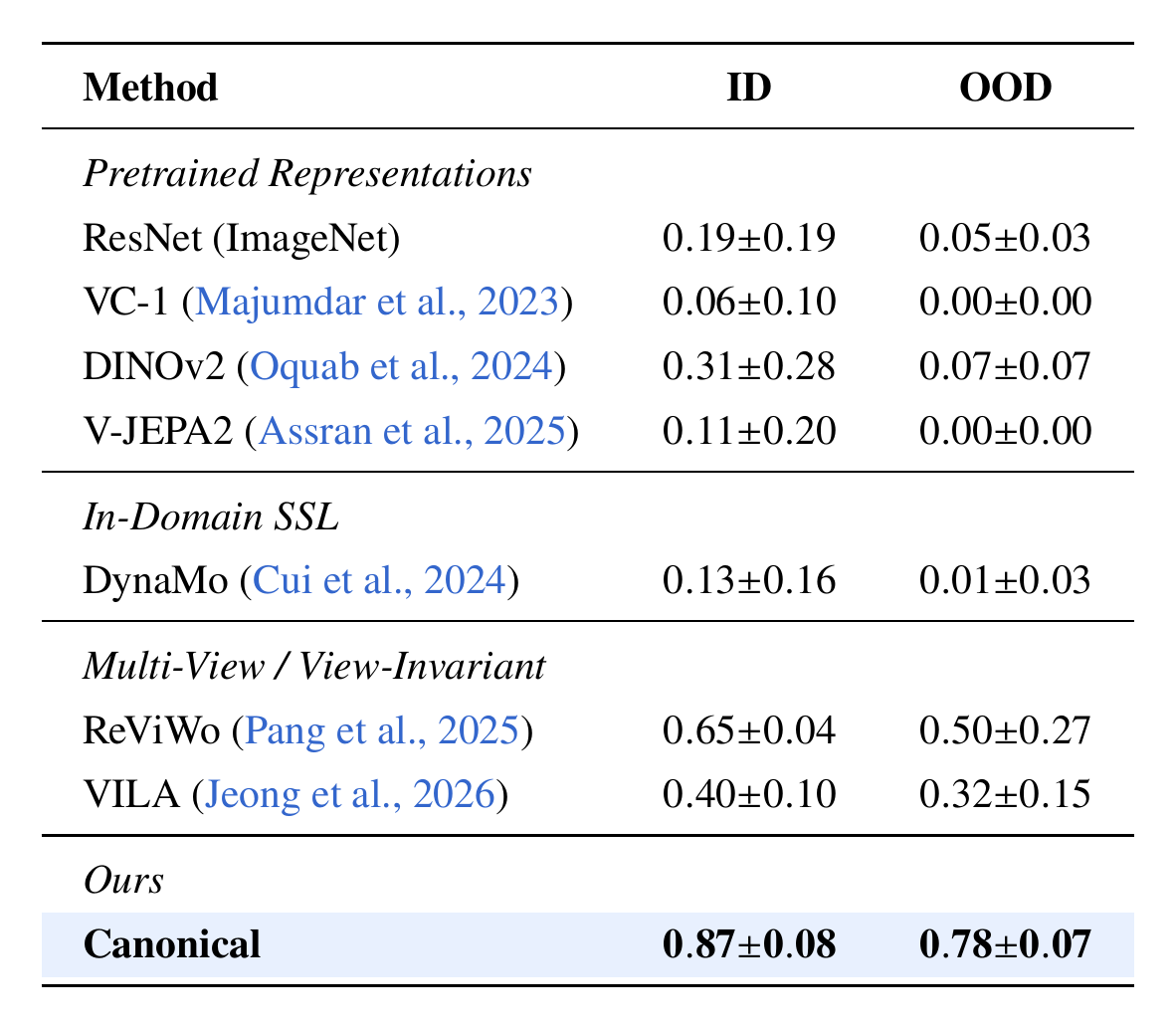
Visuomotor policies learned from human demonstrations are brittle to camera viewpoint changes. Existing remedies each make a different assumption: novel-view synthesis requires a rendering pipeline, equivariant architectures require 3D inputs or symmetry hard-coded into the network, and view-invariant pretraining requires only multi-view RGB but does not model how a viewpoint change acts on the features. We present Canonical, a self-supervised pretraining method that instead keeps viewpoint as a recoverable latent factor, modeling camera viewpoint change as a rotation in SO(3) and warping features into a shared canonical frame before a standard behavior-cloned policy that needs no viewpoint-specific changes. Pretraining consumes multi-view RGB and one rotation label per camera; at deployment an angle predictor recovers the rotation from the image itself, requiring no pose information. Canonical generalizes to camera viewpoints unseen by the policy, reaching 0.87 success at pretraining-pool views and 0.78 outside the pool on vision-only LIBERO-Goal against the strongest multi-view baseline's 0.65 and 0.50; on MetaWorld's main camera split it is the only tested visual representation that does not degrade a proprioceptive policy under viewpoint shift, and it remains the strongest method at viewpoints unseen by the policy on a real-world xArm robot.
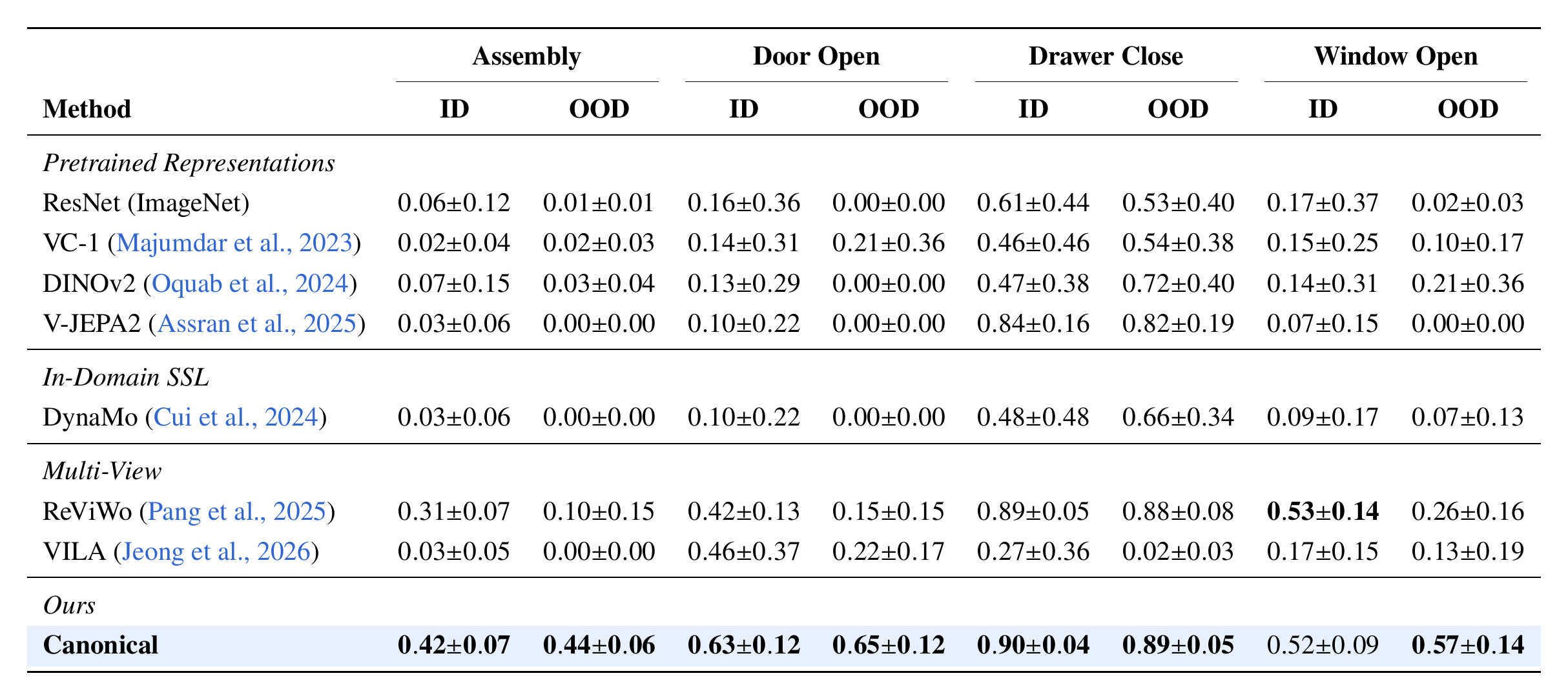
MetaWorld tests viewpoint shifts with fixed cameras spanning azimuth and elevation; a policy trained from a single canonical view is evaluated as the camera circles the scene.

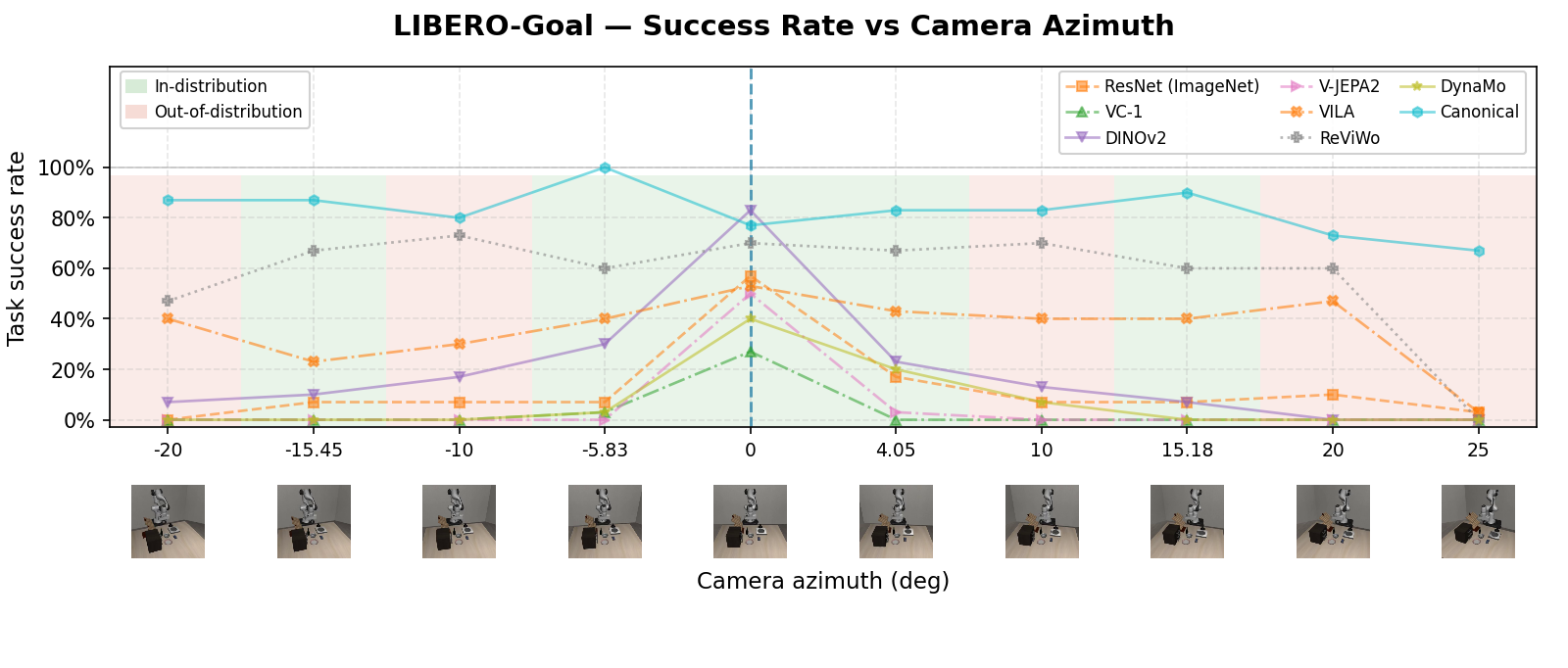
LIBERO-Goal adds a distinct robot embodiment, a richer scene, and multi-step tasks (for example, opening a drawer and then placing a bowl inside), testing whether the canonicalization carries over to long-horizon control. Occlusion from tabletop objects limits the meaningful azimuth range to roughly ±20°.

At test time, Canonical estimates the camera rotation from the observation and canonicalizes features before they reach the policy. Each carousel shows rollouts of one task recorded from different held-out camera views.
Button press
Pick-and-place
Drawer close
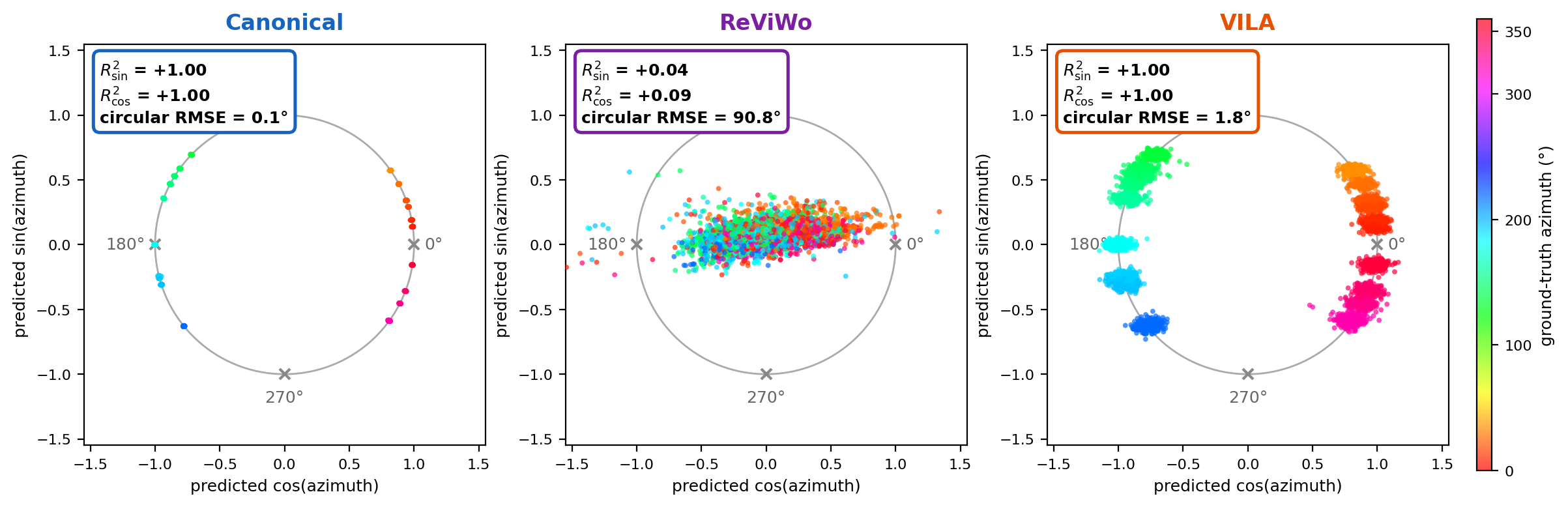
Canonical generalizes where view-invariant methods fail because it preserves viewpoint as a recoverable latent factor instead of discarding it. On MetaWorld, we freeze each encoder and fit a linear least-squares probe on its features to predict \(\cos\theta\) and \(\sin\theta\) of the camera azimuth \(\theta\) (the encoder is never updated), then place each sample at its predicted \((\cos,\sin)\).
The same canonicalization is visible directly in pixel space. On the real xArm, we freeze each encoder and train a small decoder to invert the policy-facing feature back to an image with a pixel reconstruction loss; the encoder is never updated, so the decoder can only surface what the feature already encodes. At test time we decode each method's policy-facing feature and check whether it matches the shared canonical view.


ΔSSIM = SSIM(decoded, canonical) − SSIM(decoded, source), mean over three tasks; positive means the reconstruction moves toward the canonical view.
@inproceedings{yeung:2026:canon,
  title={Canonical Observation Pretraining for Visuomotor Control},
  author={Yuen-Hei Yeung and Christopher Hoang and Zifan Zhao and Mengye Ren},
  year={2026}
}